

The complete guide
How to Choose a Silk Pillowcase for a Contour Memory Foam Pillow
The problem with putting a flat case on a curved pillow
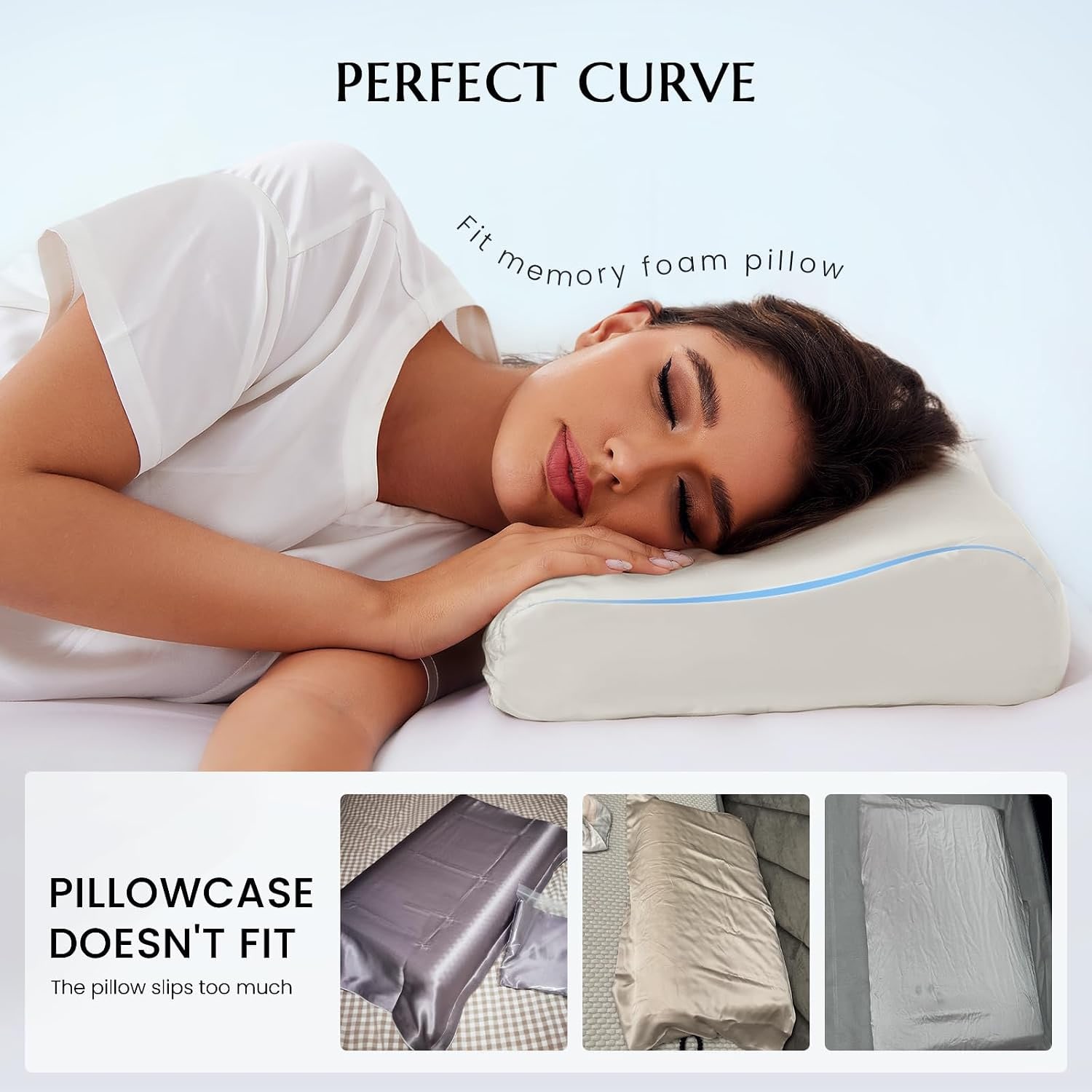
If you sleep on a contour memory foam pillow, you have probably already discovered that most pillowcases were not designed with you in mind. A standard rectangular case is built for a standard rectangular pillow. Stretch it over two curved waves and a central dip, and the fabric has nowhere useful to go. It bridges the hollow, bunches at the ends, and works itself loose over a few hours of normal movement.
The result is a pillow that performs worse than it should. The whole point of a contour shape is that the higher wave supports your neck while your head sits in the lower section. When a loose pillowcase lifts away from the foam, you lose some of that contact. You also end up with a ridge of fabric exactly where you do not want one.
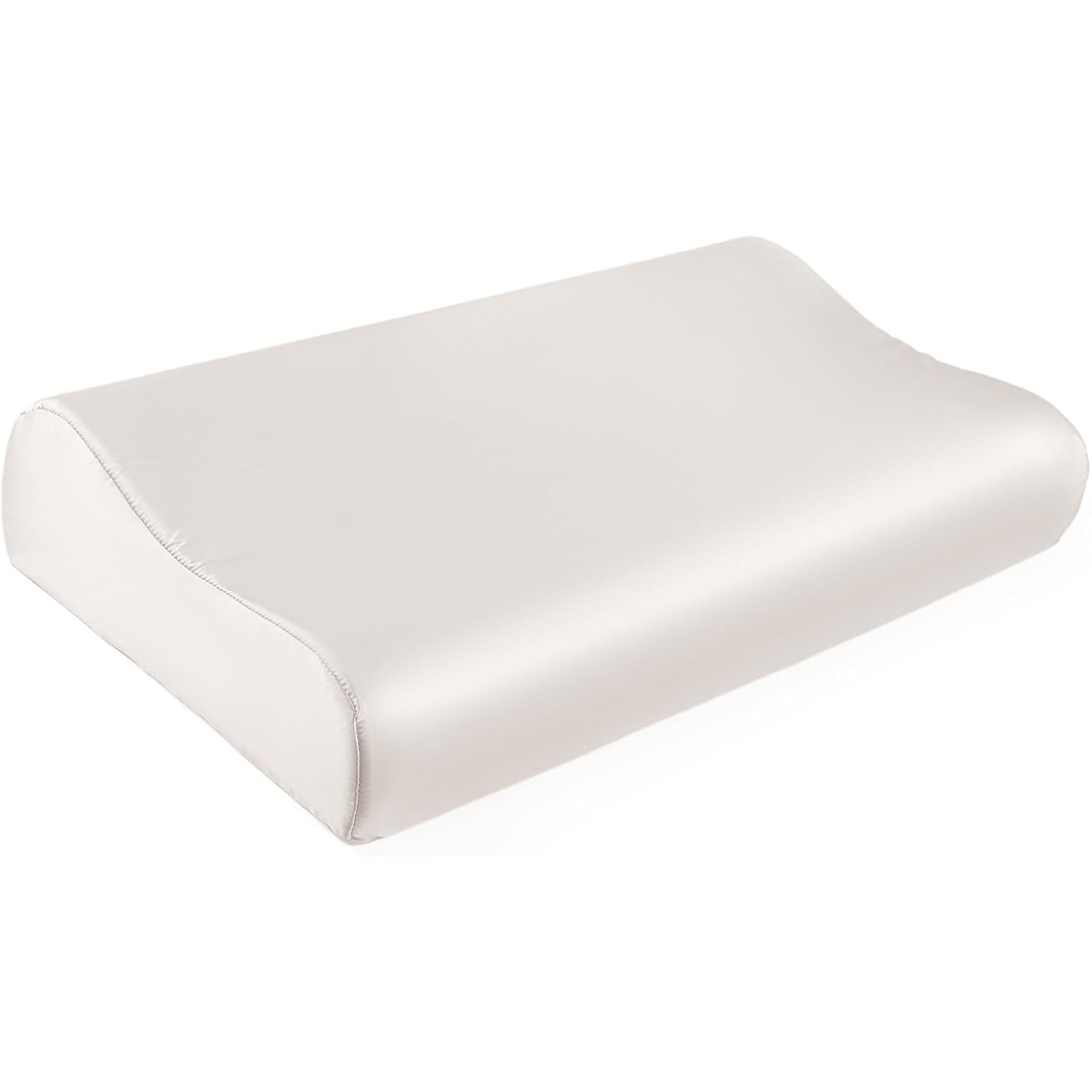
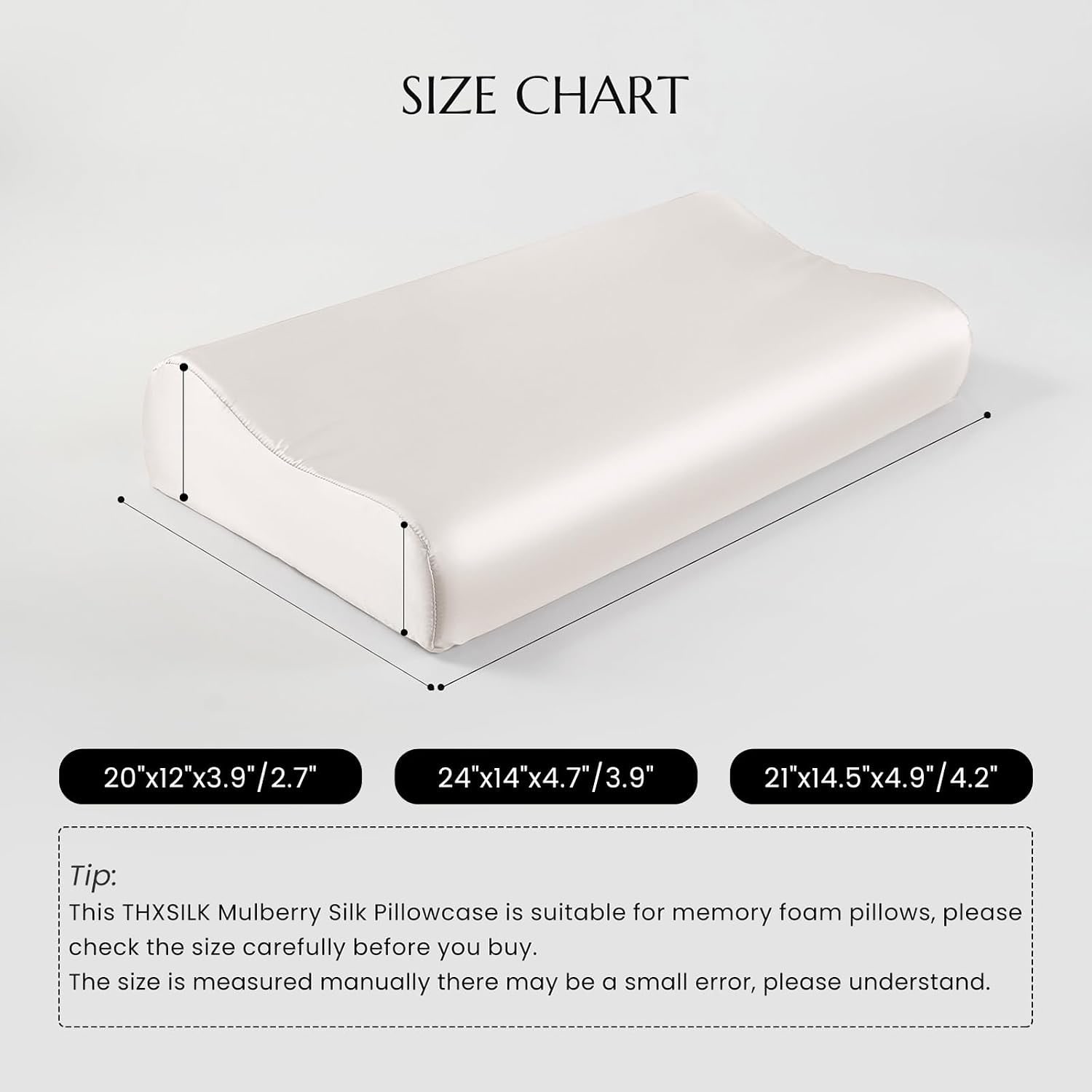
A shaped cover fixes that by following the pillow instead of covering it. This one is cut at 50 x 30 cm with a 10 cm high end and a 7 cm low end, which is the profile used by most cervical contour pillows sold today.
What 19 momme silk actually tells you
Silk bedding is not sold by thread count the way cotton is. It is sold by momme, written as mm or momme, which is a weight measure. The higher the number, the denser and heavier the fabric.
Nineteen momme sits in the useful middle. Below about 16, silk starts to feel thin and will not take repeated washing well. Above about 25, you are paying considerably more for weight you may not notice on a pillow. Nineteen gives you a fabric with enough body to hold its shape, enough density to survive a weekly cold wash, and a smooth face that still feels light.
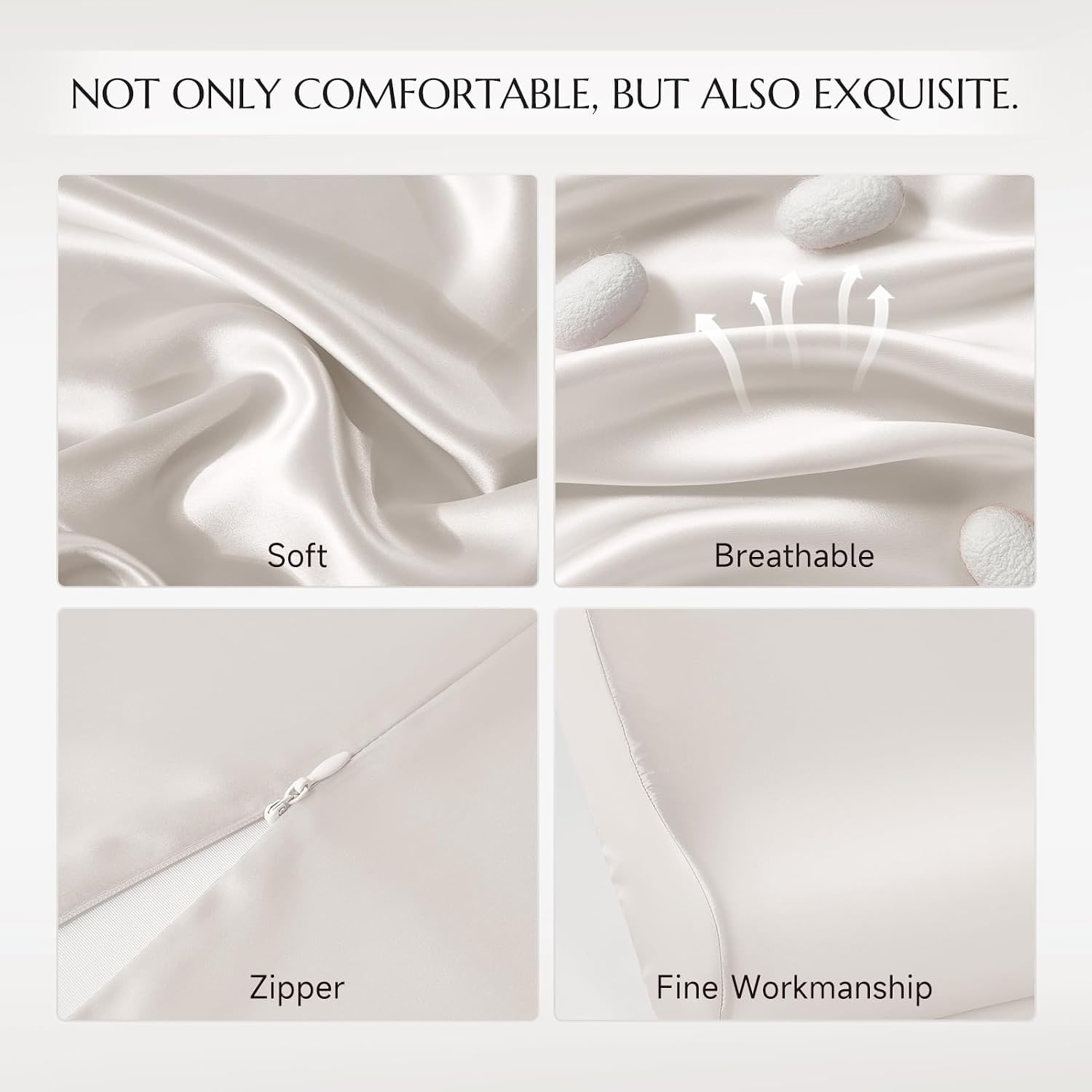
Mulberry silk refers to the source. Silkworms fed exclusively on mulberry leaves produce long, uniform fibres, which is what gives the finished cloth its even surface. That smoothness is the practical difference you feel. Hair and skin slide across silk with less drag than they do across woven cotton, which is a property of the fabric itself, not a coating or treatment that wears off.
Why the hidden zip matters more than it sounds
Closure type is one of those details people skim past, and then regret. An envelope closure on a contour pillow leaves a flap over the end of the foam, which bunches under the curve. A visible zip puts a strip of plastic teeth somewhere near your face.
A hidden zipper tucked into the seam does both jobs quietly. It secures the foam core properly, so the pillow cannot slowly work its way out while you turn over. And because it sits under the fabric edge, you are not sleeping against hardware.
It also makes removal straightforward. You will be taking this cover off regularly, so a closure that opens cleanly along one side saves a lot of small frustrations.
Who this suits
The obvious answer is anyone already sleeping on a contour memory foam pillow who wants a cover that fits it properly. But there are a few specific situations where it earns its place.
Side sleepers who use a contour pillow for neck support get the most benefit from a snug fit, because the wave height is doing real work and slack fabric undermines it. People with long hair often look for silk specifically, since the smooth surface means less snagging as you shift position. And anyone who has tried to keep a memory foam pillow clean knows the frustration of a core that cannot go near a washing machine. A removable, washable silk layer is the practical answer to that.
It is a single pillowcase, so couples sharing a bed with two contour pillows will need a pair. Having a third as a spare is also sensible, since it means the bed is never without one on wash day.
How to check the fit before you buy
Take two minutes with a tape measure. Lay your contour pillow flat and measure the length end to end, then the width front to back. Then measure the height of the taller wave at its peak, and the height of the shorter wave.
You are looking for something close to 50 cm long, 30 cm wide, with waves around 10 cm and 7 cm. Small variation is fine, since silk has a little give and a case that is marginally generous will still sit well. A pillow that is significantly longer or wider than those figures will not work, and neither will one with wave heights far outside that range.
Contour pillows are not standardised across brands, which is exactly why this check matters. The time to find a mismatch is before the parcel arrives, not after.
Living with silk: the care routine
Silk has a reputation for being fussy. It is not, really. It just wants different treatment than cotton.
Wash cold, on a gentle cycle, with a detergent formulated for silk, wool or delicates. Avoid anything with enzymes, optical brighteners or bleach. Those ingredients are designed to break down organic matter, and silk is a protein fibre, so they are working against you.
Put the pillowcase in a mesh laundry bag if you have one, and wash it apart from towels, denim and anything with zips or hooks. Snags come from contact with rough fabric far more often than they come from the machine itself.
Hang it to dry somewhere with airflow but out of direct sunlight. Sun fades silk and weakens the fibres over time. A cool tumble setting is listed as acceptable if you need it, but air drying is kinder and silk dries fast anyway.
If you want it crisp, iron on a low setting while the fabric is still slightly damp. Pressing bone-dry silk with a hot iron is how you get a permanent shine mark.
Follow that routine and 19 momme silk handles regular use comfortably. Ignore it, run it hot, and you will be disappointed much sooner.
A note on what silk does and does not do
It is worth being plain about this. Silk is a smooth, breathable, light fabric. Hair and skin move across it with less friction than they do across a cotton weave. That is a measurable property of the material.
Beyond that, be sceptical of big promises. A pillowcase is a pillowcase. Buy this one because the shape fits your pillow, the fabric feels good, and the cover washes easily. Those are solid, verifiable reasons, and they are enough.
How it compares to the cover that came with your pillow
Most contour memory foam pillows ship with a knitted polyester or poly-cotton jersey cover. Those covers are cheap to produce, they stretch over the shape adequately, and they do the basic job.
What they tend not to do is feel particularly nice, and polyester jersey holds warmth against your face in a way that some people find uncomfortable in summer. Silk is a different experience. It feels cooler on first contact and has a slip to it that a knitted cover does not.
Keeping the original cover is still sensible. Use it as the inner layer and the silk case as the outer one, and you have a pillow with two washable layers and a foam core that stays protected.
The short version
This is a shaped silk cover for a contour memory foam pillow, made from 19 momme pure mulberry silk in plain white, closed with a hidden zip, and sized at 50 x 30 x 10/7 cm.
Measure your pillow first. If the numbers line up, you get a cover that actually follows the contour rather than fighting it, a smooth surface for hair and skin, and a washable layer protecting a foam core that cannot be washed itself.
Wash it cold and gentle, keep it out of the sun, and it will look after itself. Orders arrive in 3 to 7 working days, and returns are open for 14 days from delivery on unused, unwashed items.