
The complete guide
How to Choose and Wear a 53cm Silk Neckerchief
The problem with most accessories
Most accessories commit you to something. A statement necklace decides the tone of the outfit before you have left the bedroom. A heavy wool scarf only makes sense for four months of the year. A hat has to match your head, your hair and your mood all at once.
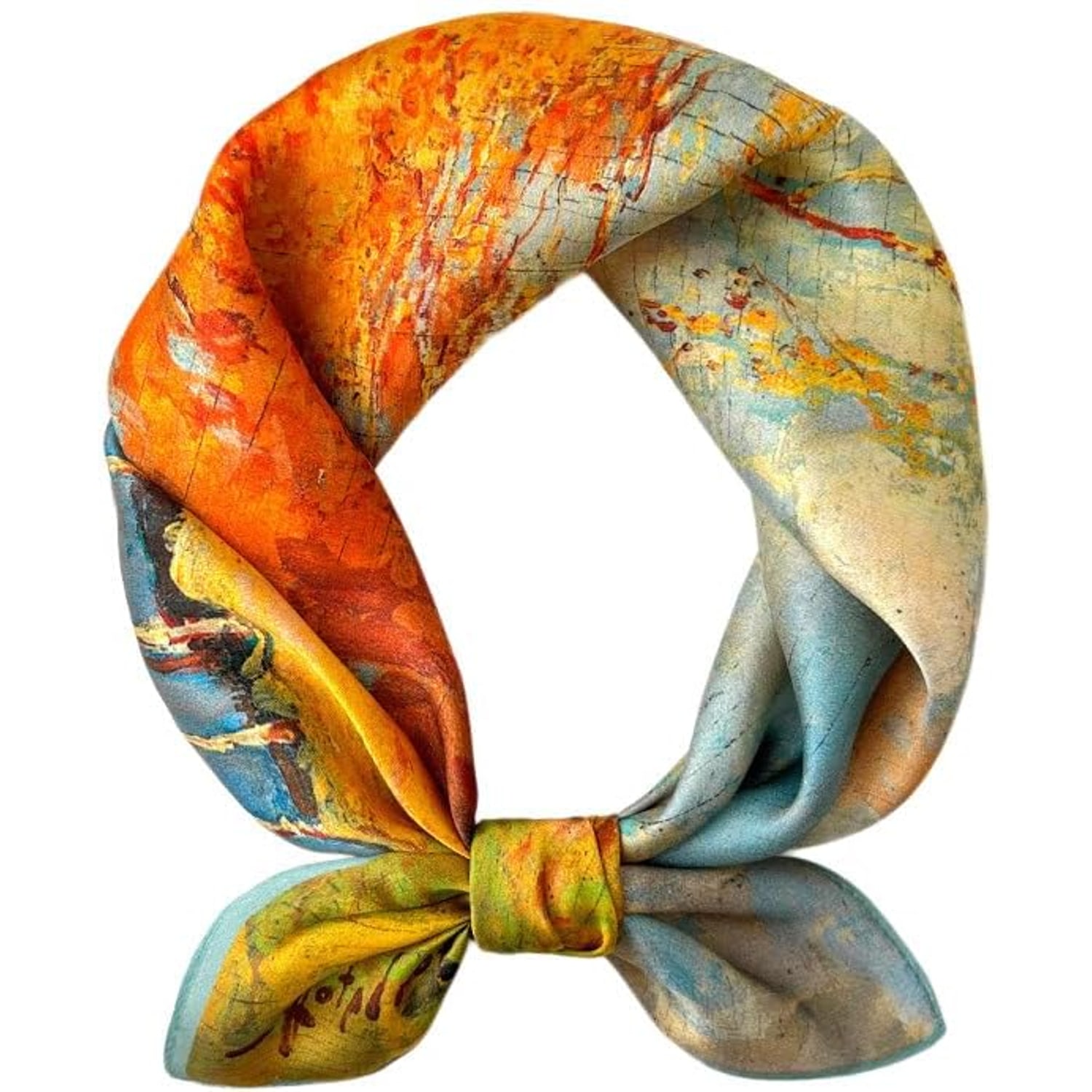
A small silk square does almost none of that. It is light, it folds flat, and it changes character depending on how you tie it. Worn as a thin roll under a collar it reads tailored. Worn as a loose knot over a plain t-shirt it reads casual. The same piece of cloth does both jobs without you owning two of them.
That flexibility is why a 53 x 53 cm neckerchief tends to be the first silk square people buy, and the one they keep reaching for after they have bought bigger ones.
What you are actually buying
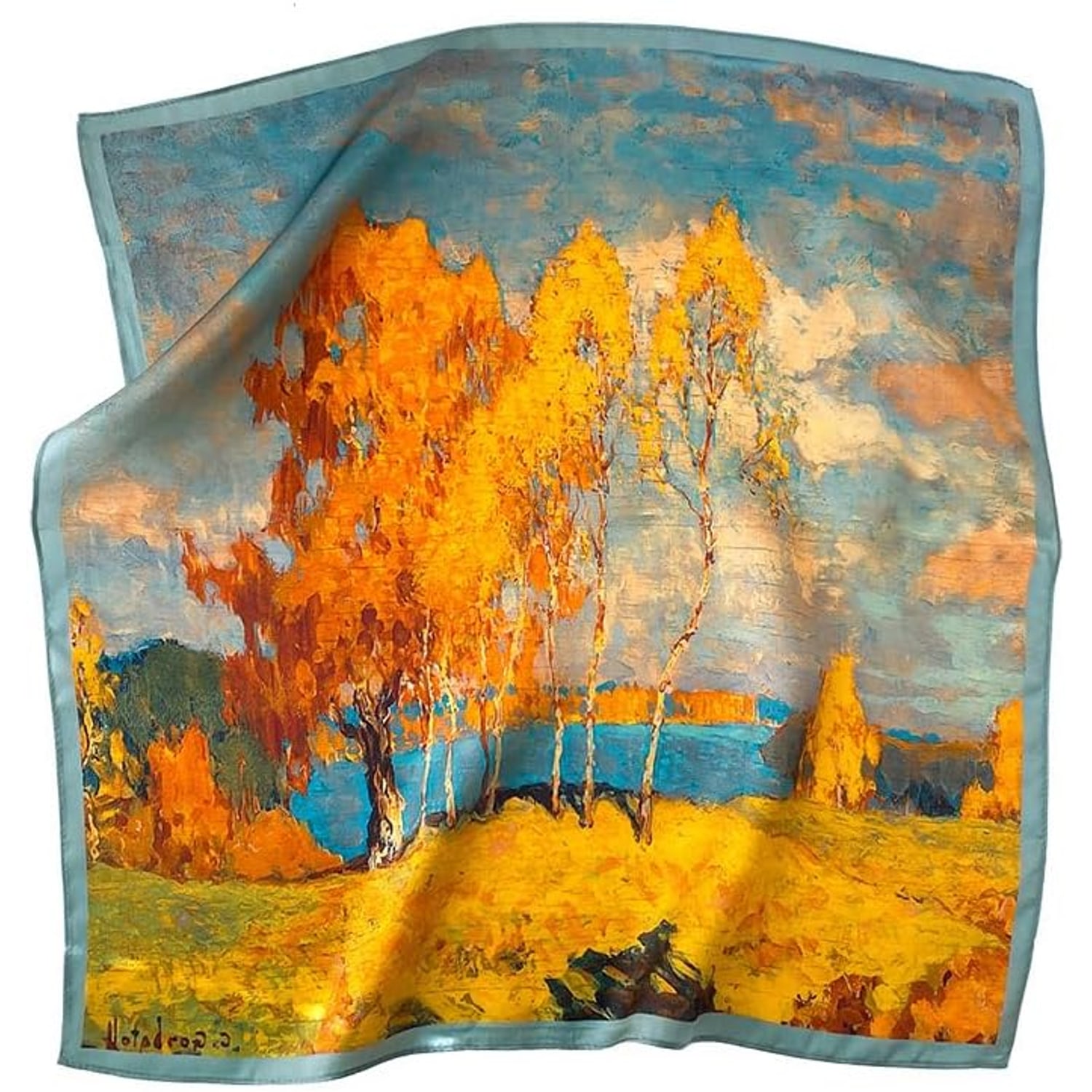
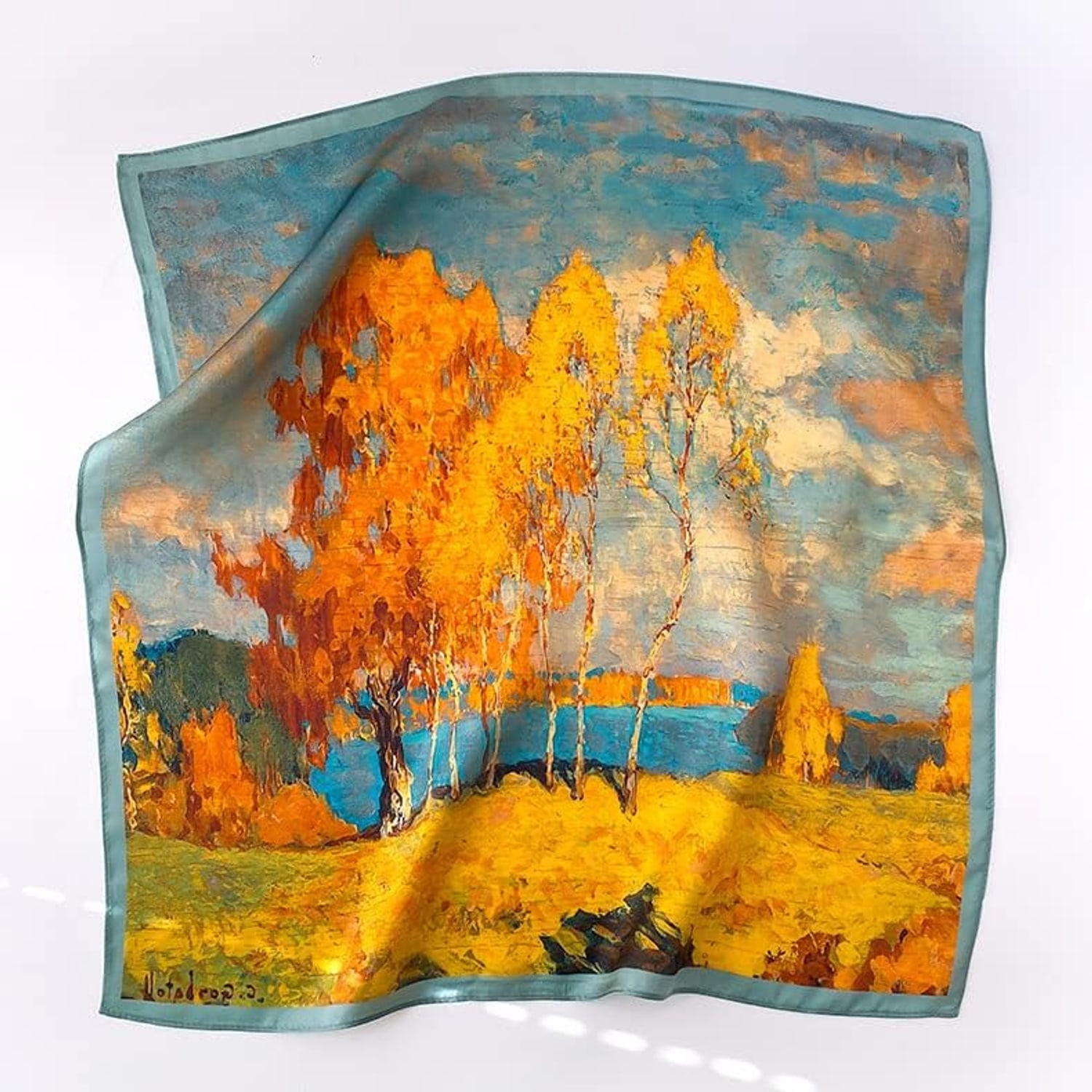
This scarf is 100% pure mulberry silk, cut as a 53 x 53 cm square, with a digital print on one side.
Each of those three facts matters in a practical way.
Mulberry silk comes from silkworms raised on a mulberry-leaf diet, which produces unusually long and even filaments. Long filaments mean fewer joins in the yarn, and fewer joins mean a smoother, more consistent cloth. That is the technical reason silk feels the way it does against the skin, and why it slides over hair with less friction than a cotton fabric would.
The 53 cm size is the classic neckerchief measurement. It is large enough to fold into a usable band and knot without the ends disappearing, and small enough that it never bulks up at the throat. Larger squares (70 cm and up) start behaving like shawls and want a different style of knot.
The digital print sits on one face. Digital printing is good at fine detail, so thin borders, small repeated motifs and colour transitions stay sharp. The reverse carries a paler ghost of the same design, which is completely normal for single-side printed silk and is often used deliberately when folding.
Who it suits
If you wear a lot of plain clothing, a printed square is the fastest way to add interest without rethinking the whole outfit. A white shirt, a navy jumper, a black dress: all of them take a patterned neckerchief well.
If you work somewhere with a dress code, this is a useful piece. It reads as polished rather than showy, especially tied tight and narrow at the collar. Searches for the best silk scarf for work usually land on squares around this size for exactly that reason.
If you tie your hair up often, a silk square doubles as a hair accessory. Hair slides over silk rather than gripping it, which is why so many people treat a small square as the best silk hair scarf option when they do not want a full wrap.
And if you are buying for someone else, a square sidesteps the sizing problem entirely. There is no small, medium or large to get wrong.
How to choose a square silk scarf
A few things are worth thinking about before you commit.
Size. 53 cm is the neckerchief standard. Go up to 70 or 90 cm only if you specifically want to wear it over the shoulders or as a head wrap with long tails. For neck, hair and bag use, 53 cm is the sweet spot.
Silk content. Look for 100% silk rather than a blend. Blends with polyester or viscose can look similar in a photograph but feel different in the hand and behave differently when knotted. This one is pure mulberry silk.
Print placement. Single-side printing is standard at this size and price. Double-sided and hand-rolled hems exist at higher price points. Neither is better for everyday wear; they are just different levels of finish.
Pattern scale. On a small square, a busy pattern mostly disappears into the folds. Bolder motifs and clear borders show up better once the scarf is tied. Keep that in mind when you are looking at the flat-lay photos.
Four ways to tie it
Start every knot by folding the square corner to corner into a triangle. From there:
The side knot is the simplest. Roll the triangle loosely from the long edge toward the point, wrap it around your neck, and tie once off to the side. Leave the tails short.
The collar roll is tighter. Fold the triangle into a narrow band, wrap it twice, and tie a small knot that sits in the hollow of the throat. Works best under an open shirt collar.
The headband uses the same narrow band, laid across the hairline and knotted underneath at the nape or on top at the side, depending on how visible you want it.
The bag loop needs no folding skill at all. Thread it through the base of a handbag handle and tie a flat knot or a loose bow, letting the tails move when you walk.
There is no wrong version. Silk forgives an imperfect knot because it drapes instead of holding a crease.
Looking after it
Care is the part people worry about most, and it is simpler than it sounds.
Wash it by hand, on its own, in cool water below 30 degrees Celsius. Use a gentle detergent made for delicates if you have one. Do not put it in the washing machine, even on a delicate cycle, and never use bleach.
When it comes out of the water, do not wring it. Press it between your palms or roll it in a towel to lift the water out. Then lay it flat or hang it somewhere shaded. Direct sunlight is the main enemy of printed colour over the long term.
If it needs smoothing afterwards, iron on a low setting. Putting a thin cotton cloth between the iron and the silk protects the surface from shine marks.
Alternatively, take it to a dry cleaner. Dry cleaning is explicitly fine for this scarf and is the easiest route if you would rather not hand wash.
For storage, fold or roll it loosely into a drawer. Avoid hanging it on a hook with a sharp edge, since that is how most snags happen.
Small things that make a difference
A couple of habits will keep a silk square looking new for years.
Put it on last, after perfume and hairspray have dried. Alcohol-based sprays can mark silk.
Watch your jewellery. Watch clasps, ring settings and rough bracelet links are the usual culprits behind pulled threads.
Give it a rest between wears rather than knotting the same spot every day. The fabric recovers better that way.
The short version
A 53 x 53 cm printed mulberry silk neckerchief is a small, genuinely useful accessory. It is 100% pure silk, digitally printed on one side, and light enough to live in a pocket.
Wear it at the neck, in your hair, on your wrist, around a hat or on a bag. Hand wash it cool or dry clean it, keep it away from bleach and strong sun, and iron it low if needed.
It is the kind of thing you buy once and end up using far more often than you expected.