
The complete guide
How to Choose a Silk Sleep Mask That Actually Blocks the Light
The problem is almost never the bed
People spend a fortune on mattresses and pillows and then wonder why they still wake at five. A lot of the time the culprit is light. A streetlamp through a gap in the curtains, a partner's phone, the glow of a charging cable, the sun coming up earlier than you would like in summer. Your eyelids are thin. They let a surprising amount of light through, and your body reads that light as a signal to start the day.
A blackout room fixes this, but most of us cannot blackout a room. You are renting, or the window is an odd shape, or you are in a hotel with curtains that refuse to meet in the middle. That is the gap a sleep mask fills. It is the cheapest piece of sleep equipment you can buy and often the one that makes the most immediate difference.
The catch is that most masks do not work very well. They slide. They press. They leave a gap at the nose where light pours in. Understanding why is the whole game when you are shopping for one.
Where cheap masks let you down
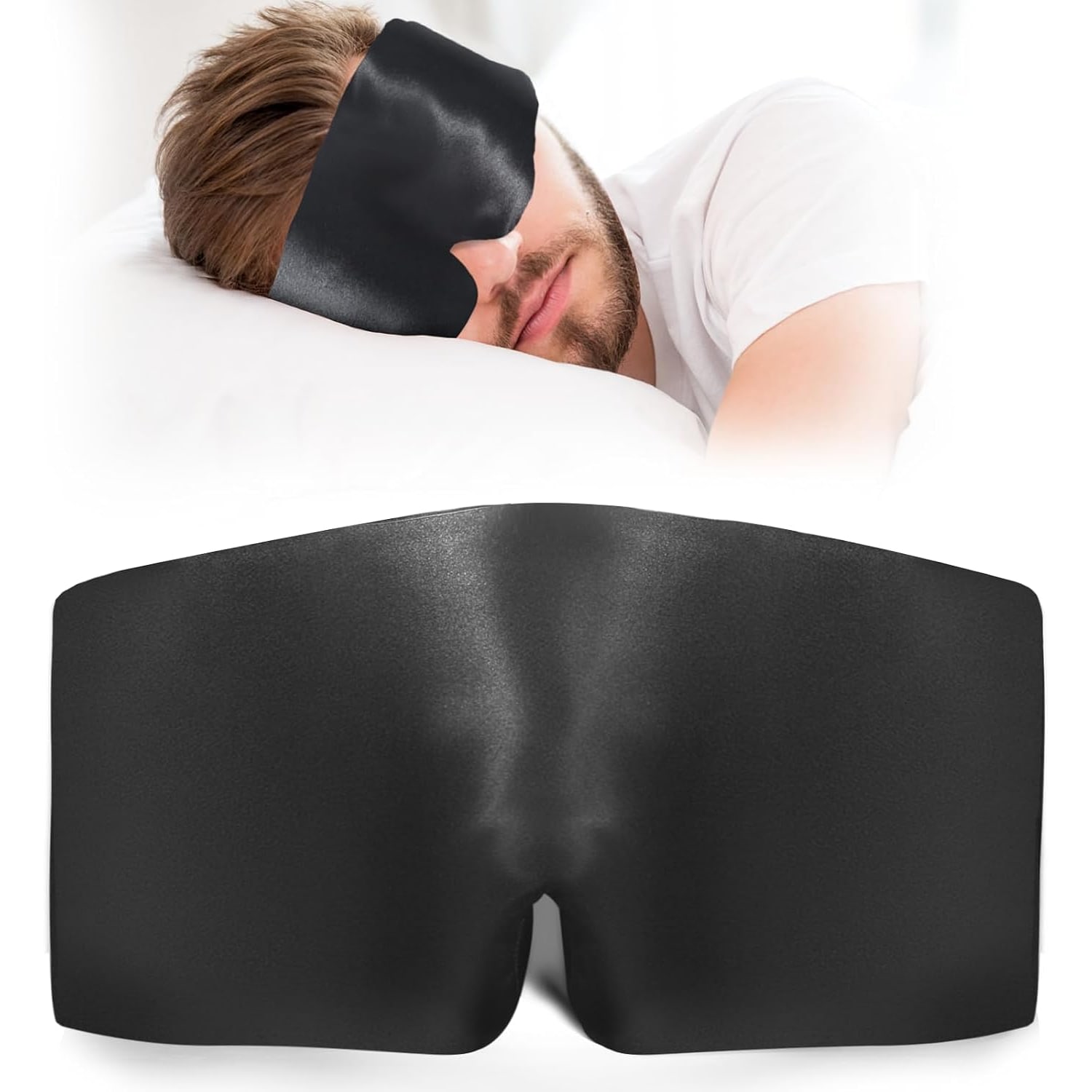
Pick up a standard flat mask and look at its profile. It is a flat rectangle of padding with an elastic loop. When you put it on your face, the nose sticks out and the fabric has to bridge over it, leaving two small open triangles either side. In a dim room you never notice. At sunrise, those triangles are two spotlights aimed at your eyes.
The second failure is pressure. A thin elastic band concentrates all the tension in one narrow line across the back of your head and along the temples. Add a plastic slider or buckle and you now have a hard lump you cannot lie on. Side sleepers feel this within minutes.
The third is the fabric itself. Polyester satin looks like silk in a photograph but behaves differently against skin. It does not breathe as well, it warms up, and it tends to crease and stay creased. A mask that is only silk on the outside has the same problem, because the layer touching your face is the one that matters.
What 22 momme gives you
Momme is how silk weight is measured. Think of it as the silk equivalent of GSM. Lower momme silks, around 16 to 19, are light and fine. They are lovely for scarves but they go limp quickly when used for something worn every night.
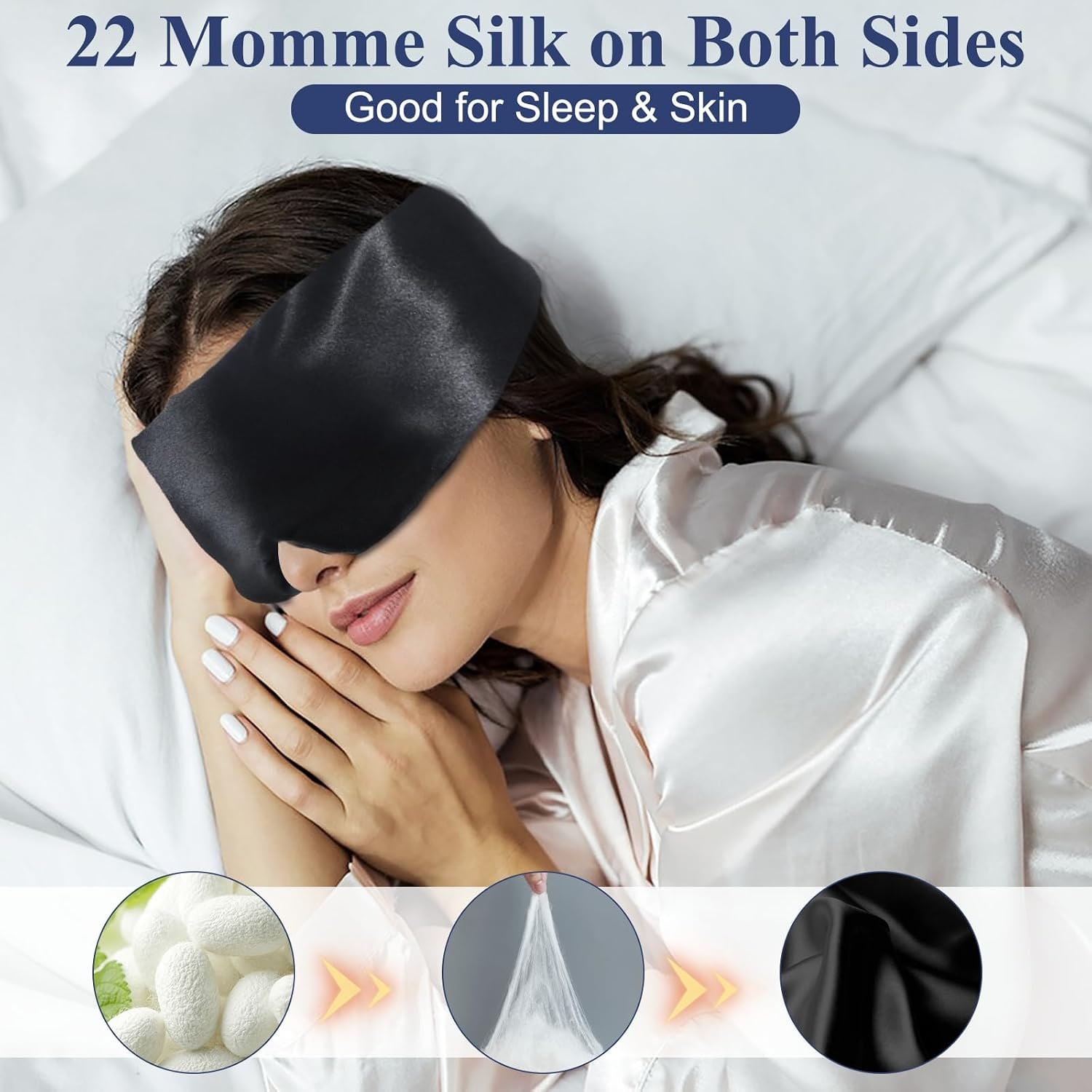
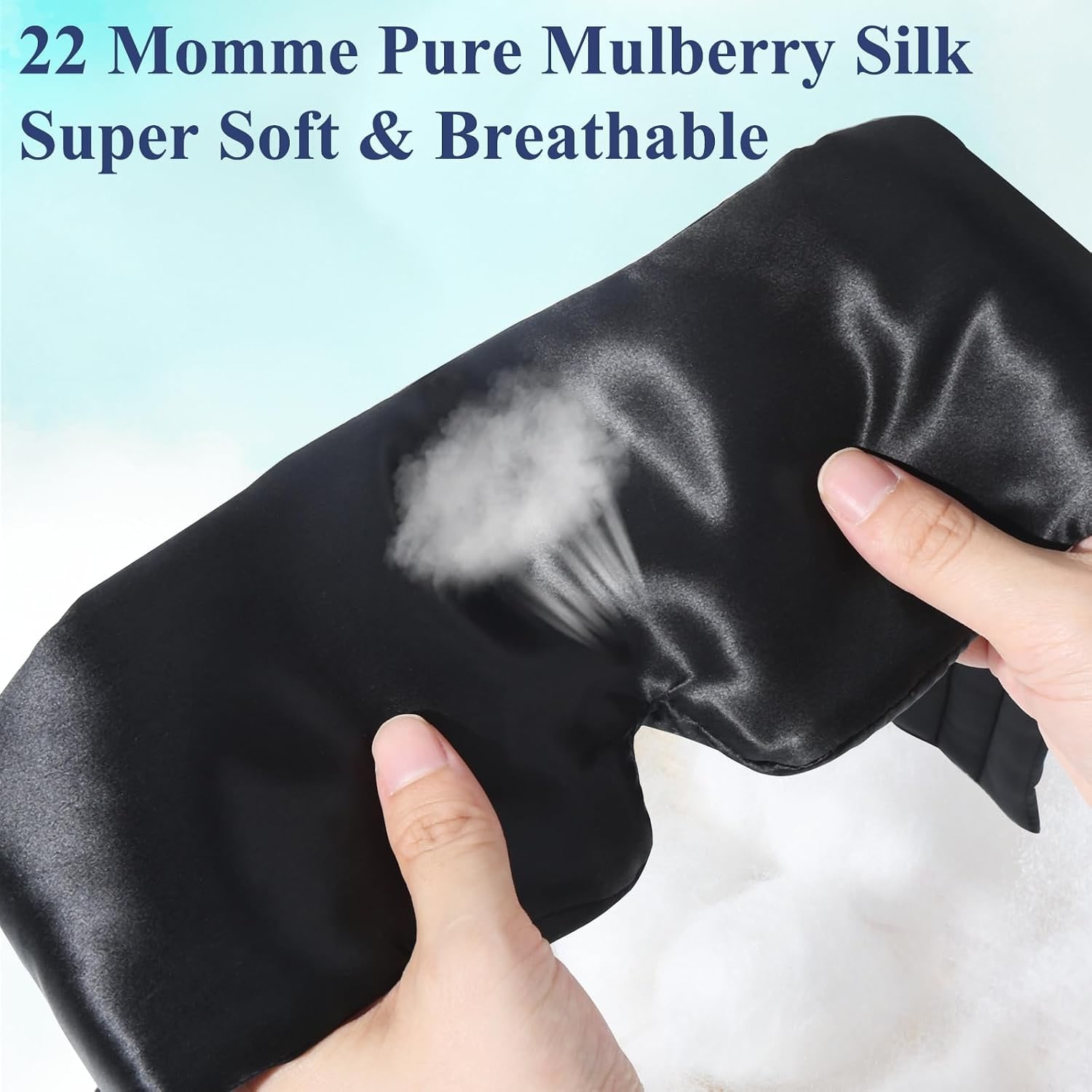
At 22 momme you get a noticeably denser fabric. It has structure. On a sleep mask that matters in two practical ways. First, the silk holds its shape over the eye socket instead of flattening down onto your lashes, so there is a small pocket of air in front of each eye. Second, denser fabric blocks more light on its own, before the shaping even gets involved.
This mask is 22 momme on both sides, which is worth checking whenever you shop. A listing that says "silk" without specifying both faces is often silk on the outside with something cheaper on the inside. The lining is the half your skin touches for seven or eight hours, so it is the half that should be good. Smooth silk also means less friction against skin and hair than cotton, which is why people who sleep face down on a cotton pillowcase tend to notice the difference quickly.
Shape and fit are what separate good from average
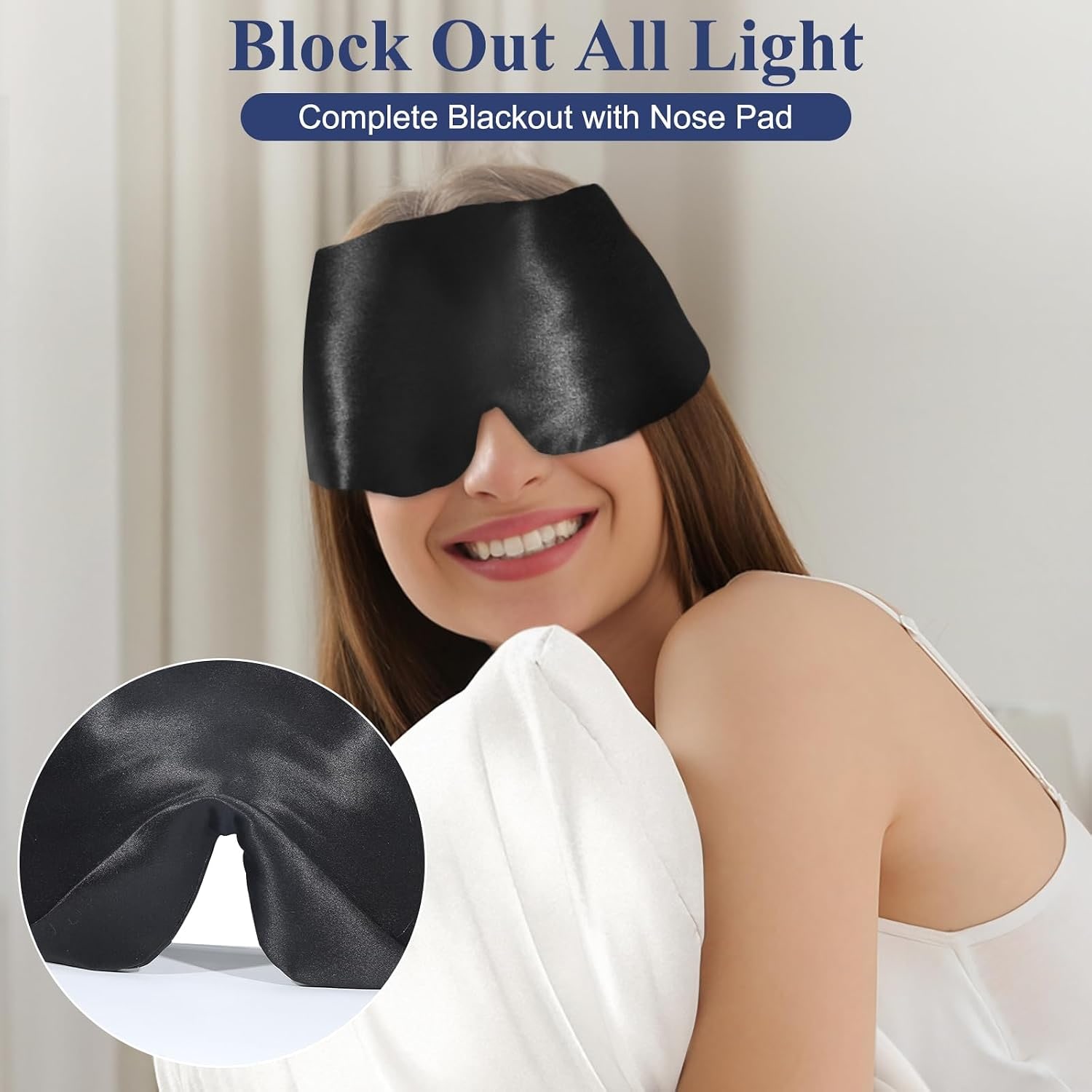
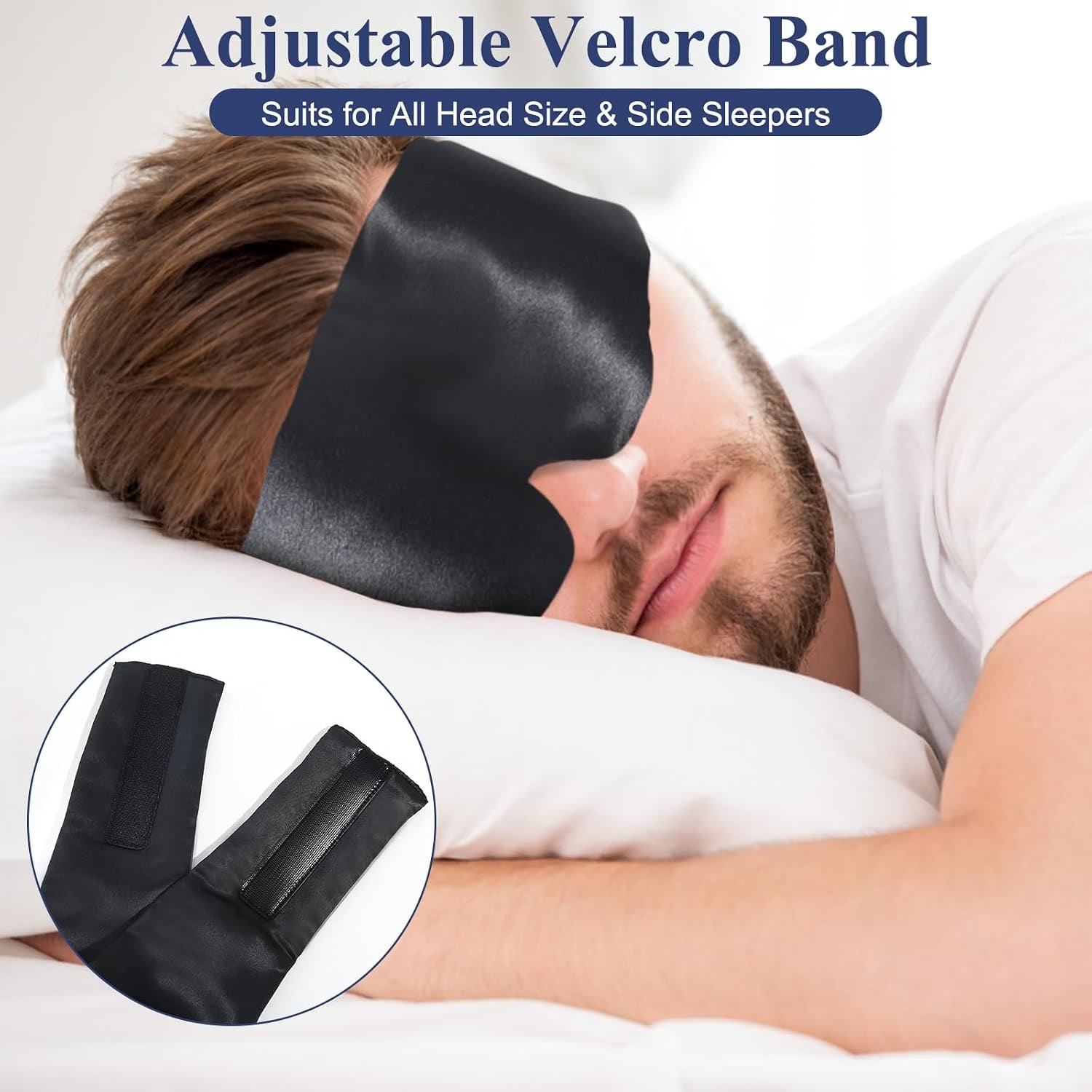
The nose pad is the single feature that changes how dark a mask feels. A contoured pad sits down against the bridge of your nose and fills the gap a flat mask leaves. It does this without clamping your nose, because the pressure is spread across the whole band rather than concentrated at one point.
The band on this mask is wide and cushioned for the same reason. Wide bands distribute load. Narrow ones cut in. If you have ever taken a mask off in the morning and found a red line across your face, you have met a narrow band.
Then there is the closure. A hook and loop strap lets you set the exact length that suits your head and keeps it there. More importantly, it means no hard buckle at the back. Lie on your side with a buckled mask and you will feel the buckle against your skull inside five minutes. Without one, you can roll freely. That is why this style tends to get recommended as the best adjustable silk sleep mask for people who move around at night.
Who this suits
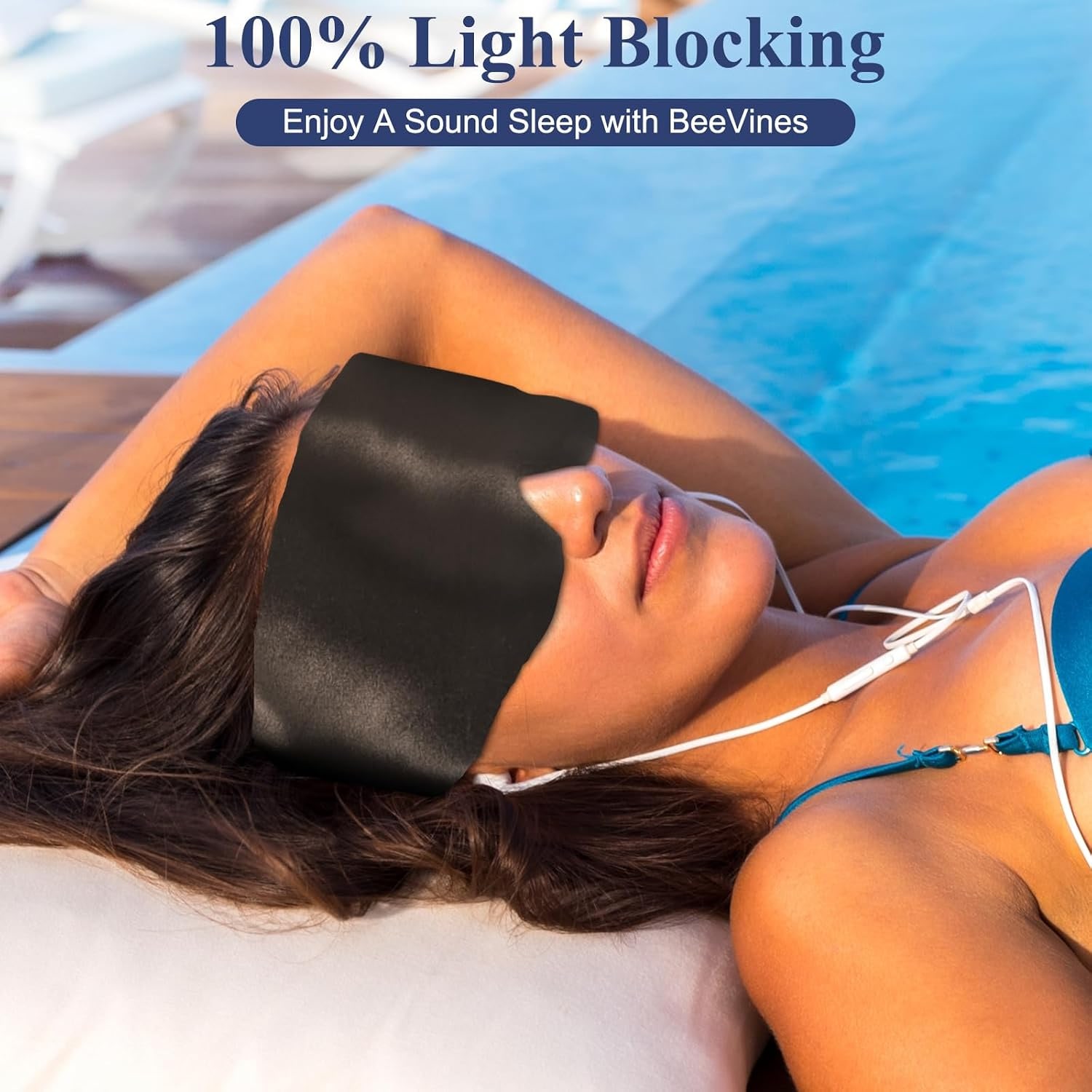
Shift workers are the clearest case. If your sleep happens between nine in the morning and four in the afternoon, no amount of curtain is going to beat a mask for convenience. Travellers are next. On a long-haul flight the cabin lights come up on someone else's schedule, and a light mask that packs flat is the simplest way to take control of that.
Beyond that, it is anyone sharing a space with a different routine. A partner who reads late, a flatmate with the hallway light on, a baby monitor glowing on the dresser. Campers deal with canvas that lights up at dawn. Hospital patients deal with corridor lights all night. The common thread is that you cannot change the room, so you change what reaches your eyes.
It also works for people who just want to rest without sleeping. Twenty minutes with a mask on, lying down in a bright lounge room, is a genuinely useful reset in the middle of a long day.
How to choose between options
Start with momme. Anything under 19 will feel thin. Twenty-two is a sensible place to land for something worn nightly.
Check that both sides are silk, not just the outer. Then look at the nose area in the product photos. If the profile is a flat rectangle, expect light leaks. If there is a visible contour or pad, that is a better sign.
Look at the closure next. Hook and loop or a buckle-free adjustable band will serve you better than fixed elastic if you move in your sleep. Finally, think about colour. Black is the practical pick. It does not bounce stray light back towards your eyes and it hides the marks that any face-worn item eventually picks up.
Size is less of a worry than people expect with an adjustable strap, which is part of why a mask like this makes an easy gift.
Looking after it
Silk is not fragile, but it does not like heat or harsh detergent. Hand wash in cool water with something made for delicates. Press the hook and loop closed first so it cannot snag the fabric while it moves around. Do not soak it, do not bleach it, do not wring it out.
To dry, roll it in a towel to press the water out, reshape the mask and lay it flat somewhere out of direct sun. Sunlight fades silk and heat weakens the fibres, so skip the tumble dryer entirely. If you want to iron, use the coolest setting on the reverse.
How often? Most people land on weekly. If you use serums or heavy moisturiser at night, make it more often, and give the product a few minutes to absorb before the mask goes on. Owning two and rotating them is a small habit that doubles the life of both.
The short version
Light is the most underrated reason people wake up early, and a mask is the cheapest fix available. The ones that work share three traits. Dense silk on both faces so the fabric itself blocks light and feels good against skin. A contoured nose pad so there is no gap at the bridge of the nose. A wide, buckle-free adjustable strap so you can lie on any side without a pressure point.
This black 22 momme silk eye mask ticks all three. It weighs next to nothing packed, it goes in a carry-on without a thought, and it asks nothing of you beyond a gentle hand wash now and then. If you have been blaming your mattress for a 5am wake-up, try covering your eyes properly first.